
POPULATION
IN MALAYSIA, 2024
The current population estimates for administrative districts present
the population estimates in Malaysia for 2023 and 2024. The annual current
population estimates are based on the Population and Housing Census Malaysia,
2020. The population estimates use cohort-component method which comprise of
births, deaths and migration. These estimates used the bottom-up approach. The
population is estimated according to single age, ethnic group and sex at
district level.
POPULATION SIZE AND ANNUAL POPULATION GROWTH RATE
The total population of Malaysia in 2024 estimated at 34.1 million as
compared to 33.4 million in 2023 with a growth rate of 1.9 per cent. The
Citizens and Non-citizens population increased to 30.7 million (2023: 30.4
million) and 3.4 million (2023: 3.0 million) in 2024, respectively.
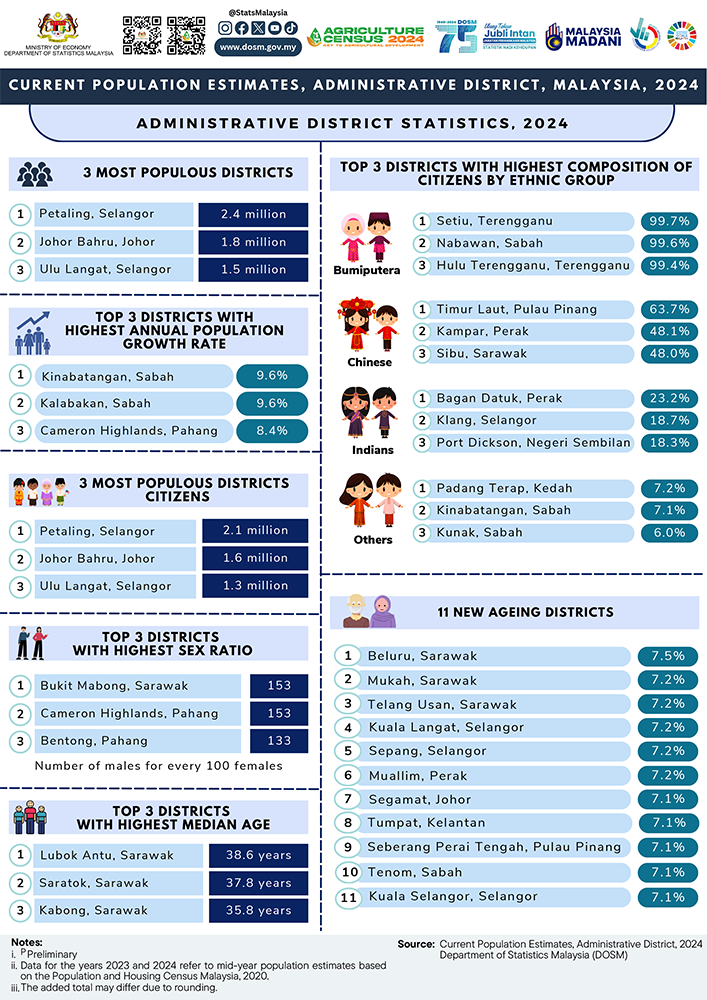
Kalabakan and Kinabatangan in Sabah recorded the highest growth rate at
9.6 per cent, followed by Cameron Highlands, Pahang (8.4%). The highest growth
rate of Non-citizens in Cameron Highlands, Pahang (41.4%) is attributed to the
influx of foreign workers in agriculture sector.
POPULATION
BY SEX
The number of males exceeded females at 17.9 million and 16.2 million
respectively contributed to a sex ratio of 111 males for every 100
females. At district level, Bukit Mabong, Sarawak and Cameron Highlands,
Pahang recorded the highest sex ratio in 2024 with 153 males per 100 females,
followed by Bentong, Pahang (133). These districts also recorded high sex ratio
in 2023.
AGE STRUCTURE
The composition of population aged 15-64 years (working age) increased
to 70.1 per cent (2024) from 69.9 per cent in 2023. The percentage of the
population aged 65 years and over (old age) increased to 7.7 per cent from 7.4
per cent for the same period. Meanwhile, the composition of population aged
0-14 years (young age) in 2024 decreased from 22.7 per cent in 2023 to 22.2 per
cent.
The highest composition of the population aged 0-14 years (young
age) at district level in 2024 was recorded in Kecil Lojing with 33.8 per cent,
followed by Gua Musang (33.4%) and Tumpat (32.3%) in Kelantan. Meanwhile,
Sebauh, Sarawak recorded the highest percentage of population aged 15-64 years
(working age) with 79.5 per cent, followed by Kinabatangan, Sabah (78.4%) and
Belaga, Sarawak (78.3%). Lubok Antu, Sarawak has the highest old age population
(65 years and over) with 15.1 per cent.
DEPENDENCY RATIO
The total dependency ratio refers to the ratio of young age (0-14 years)
and old age (65 years and over) that need to be supported for every 100
population aged 15-64 years (working age). The old age dependency ratio
(65 years and over) increased to 10.9 (2024) from 10.6 in 2023. This was
contributed by the increase of old age composition from 7.4 per cent (2023) to
7.7 per cent in 2024.
Tumpat, Kelantan has the highest total dependency ratio of 65.1 while
Gua Musang, Kelantan has the highest young age dependency ratio at 53.9. The old-age
dependency ratio was highest in Lubok Antu, Sarawak (22.4).
AGEING POPULATION
The United Nations has defined
three categories of ageing, namely ageing society, aged society and super-aged
society which refers to the population aged 65 years and over reached 7 per
cent, 14 per cent and 20 per cent respectively. Meanwhile, the National Senior
Citizens Policy (DWEN) states that ageing is when the population of 60 years
old and over comprises15 per cent of the total population.
The composition of Malaysia’s
population aged 60 years and over as well as those aged 65 years and over are
increasing over the years. The composition of population aged 60 years and over
in 2024 has increased to 11.6 per cent as compared to 11.3 per cent (2023).
Meanwhile, for population 65 years and over, the composition has increased to
7.7 per cent (2023: 7.4%).
POPULATION DENSITY
On average, Malaysia has a population density of 103 persons per square
kilometre. Petaling, Selangor has the highest population density with 4,836 persons
per square kilometre, followed by Timur Laut, Pulau Pinang (4,782 persons) and
Seberang Perai Tengah, Pulau Pinang (1,887 persons).
An Error occurred while handling another error:
yii\web\HeadersAlreadySentException: Headers already sent in /var/www/html/dosm/frontend/controllers/SiteController.php on line 191. in /var/www/html/dosm/vendor/yiisoft/yii2/web/Response.php:368
Stack trace:
#0 /var/www/html/dosm/vendor/yiisoft/yii2/web/Response.php(341): yii\web\Response->sendHeaders()
#1 /var/www/html/dosm/vendor/yiisoft/yii2/web/ErrorHandler.php(136): yii\web\Response->send()
#2 /var/www/html/dosm/vendor/yiisoft/yii2/base/ErrorHandler.php(152): yii\web\ErrorHandler->renderException()
#3 [internal function]: yii\base\ErrorHandler->handleException()
#4 {main}
Previous exception:
yii\web\HeadersAlreadySentException: Headers already sent in /var/www/html/dosm/frontend/controllers/SiteController.php on line 191. in /var/www/html/dosm/vendor/yiisoft/yii2/web/Response.php:368
Stack trace:
#0 /var/www/html/dosm/vendor/yiisoft/yii2/web/Response.php(341): yii\web\Response->sendHeaders()
#1 /var/www/html/dosm/vendor/yiisoft/yii2/base/Application.php(390): yii\web\Response->send()
#2 /var/www/html/dosm/www/index.php(24): yii\base\Application->run()
#3 {main}