
|
Labour Market in Malaysia, February 2016 |
Series 81 Vol.04/2016 |
| Indicator | Previous Month | Same month of the previous year |
||||
|
February
2016
|
January
2016
|
Change % |
Februaryr
2015
|
Change
(%)
|
||
| Labour force (‘000) | 14,703.3 | 14,652.0 | 0.4 | 14,554.7 | 1.0 | |
| Employed (‘000) | 14,196.9 | 14,150.5 | 0.3 | 14,092.9 | 0.7 | |
| Unemployed (‘000) | 506.4 | 501.5 | 1.0 | 461.8 | 9.7 | |
| Outside labour force (‘000) | 7,063.1 | 6,984.2 | 1.1 | 6,847.8 | 3.1 | |
| Labour force participation rate (LFPR) (%) | 67.6 | 67.7 | -0.1 | 68.0 | -0.4 | |
| Unemployment rate (%) | 3.4 | 3.4 | - | 3.2 | 0.2 | |
| Seasonally adjusted | ||||||
| Unemployment rate (%) | 3.2 | 3.2 | - | - | - | |
r Updated
|
Starting January 2016 Monthly Release, the labour force statistics are estimated based on the latest current population estimates. Therefore the monthly statistics labour force time series is updated. |
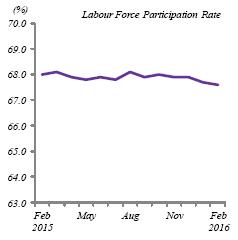 |
Labour force participation rate was 67.6% The labour force participation rate in February 2016 decreased 0.1 percentage points to 67.6 per cent compared to the previous month. Year-on-year comparison showed that the labour force participation rate decreased 0.4 percentage points compared to 68.0 per cent in February 2015.
|
|
|
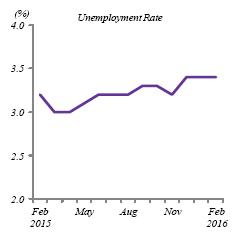 |
Unemployment rate was 3.4% The unemployment rate for February 2016 was 3.4 per cent, similar to January 2016. Year-on-year comparison showed that the unemployment rate rose by 0.2 percentage points. Meanwhile the seasonally adjusted unemployment rate was 3.2 per cent, same as was recorded in the previous month.
|
TECHNICAL NOTES
The survey population is defined to cover persons who live in private living quarters and hence excludes persons residing in institutions such as hotels, hostels, hospitals, prisons, boarding houses and construction work site.
The survey comprises of the economically active and inactive population. To measure the economically active population, the LFS uses the age limit of 15 to 64 years. The economically active population comprises of those employed and unemployed whereas those who are inactive is classified as outside the labour force.
LFS uses the actual status approach, where a person is classified on the basis of his labour force activity during the reference week.
Unemployed refers to those who do not have a job but are interested to work. There are two groups of unemployed that is the actively unemployed and inactively unemployed.
Population benchmarks
Population by characteristics of age group, ethnicity and state were used as benchmarks to produce labour statistics.
Starting with the monthly release of the Principal Statistics of Labour Force, Malaysia, January 2016, the principal statistics of labour is estimated based on the current population estimates as compared to the previous series which used population projections based on the Population and Housing Census of Malaysia, 2010. This rebase is to obtain statistics that is more consistent with current population structure.
Released By:
THE OFFICE OF CHIEF STATISTICIAN MALAYSIA
DEPARTMENT OF STATISTICS, MALAYSIA
#myHariBulan# #myBulan# #myTahun#
Contact person:
Ho Mei Kei
Public Relation Officer
Corporate and User Services Division
Department of Statistics, Malaysia
Tel : +603-8885 7942
Fax : +603-8888 9248
Email : mkho@stats.gov.my
An Error occurred while handling another error:
yii\web\HeadersAlreadySentException: Headers already sent in /var/www/html/dosm/frontend/controllers/SiteController.php on line 191. in /var/www/html/dosm/vendor/yiisoft/yii2/web/Response.php:368
Stack trace:
#0 /var/www/html/dosm/vendor/yiisoft/yii2/web/Response.php(341): yii\web\Response->sendHeaders()
#1 /var/www/html/dosm/vendor/yiisoft/yii2/web/ErrorHandler.php(136): yii\web\Response->send()
#2 /var/www/html/dosm/vendor/yiisoft/yii2/base/ErrorHandler.php(152): yii\web\ErrorHandler->renderException()
#3 [internal function]: yii\base\ErrorHandler->handleException()
#4 {main}
Previous exception:
yii\web\HeadersAlreadySentException: Headers already sent in /var/www/html/dosm/frontend/controllers/SiteController.php on line 191. in /var/www/html/dosm/vendor/yiisoft/yii2/web/Response.php:368
Stack trace:
#0 /var/www/html/dosm/vendor/yiisoft/yii2/web/Response.php(341): yii\web\Response->sendHeaders()
#1 /var/www/html/dosm/vendor/yiisoft/yii2/base/Application.php(390): yii\web\Response->send()
#2 /var/www/html/dosm/www/index.php(24): yii\base\Application->run()
#3 {main}